

 العربية
  Deutsch
  Español
  Français
  हिन्दी
  Italiano
  日本語
日本語  Melayu
  Polski
  Português
  Română
  Русский
  اُردو
اُردو  中文
中文 
Independent Cleaner vs Cleaning Company: Which?
Hiring cleaning help should take pressure off your week, not create new worries. The independent cleaner vs cleaning company choice is rarely explained clearly, so homeowners compare price alone. That can lead to missed expectations, surface damage, patchy communication or awkward conversations later. This guide gives you a practical way to choose the right option for your home, routine and level of risk.
Answers First: Independent Cleaner vs Cleaning Company
If you want the same person, direct communication and a flexible regular routine, an independent cleaner may be the better fit. If you need cover for holidays, a bigger team, formal systems and clearer escalation, a cleaning company may suit you better. The safest choice is the provider who is insured, clear about scope, realistic about time and confident with your home’s surfaces.
What Is the Difference?
An independent cleaner is usually a self-employed person you deal with directly. They may set their own prices, bring their own preferred kit, and build a personal working relationship with each household.
A cleaning company is a business that may send one cleaner or a team, manage bookings centrally, and use set checklists, service standards and complaints processes. Some smaller companies are owner-operated, so the difference is not always as simple as “one person versus a brand”.
For regular home help, start by defining the job. Scrub Bunnies’ Domestic Cleaning Services Near You page is a useful reference for routine household tasks such as dusting, vacuuming, mopping, kitchen cleaning and bathroom cleaning.
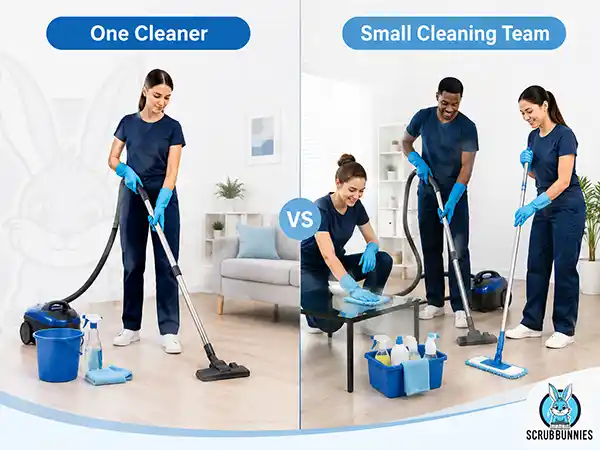 Independent Cleaner vs Cleaning Company: Key Differences to Compare
Continuity
Independent cleaners often win on continuity. The same person learns your home, your priorities, your pets, and the little details that matter, such as which taps mark easily or which room needs doing first.
Companies may offer cover when someone is away, but you may not always get the same cleaner. Ask how handovers are managed so your preferences are not lost.
Accountability
With an independent cleaner, accountability is personal and direct. That can be excellent when communication is strong, but awkward if there is a disagreement.
With a cleaning company, there is usually a manager, office or support process. This can help if you need a missed area corrected, a breakage handled, or a booking changed.
Capacity
One cleaner can be ideal for weekly upkeep. A team is often more practical for larger properties, end of tenancy cleaning, post-build dust, holiday let changeovers or a time-sensitive deep clean.
When an Independent Cleaner Works Best
An independent cleaner is often a strong choice when your home needs steady maintenance rather than a major reset. They are especially suitable if you value personal trust, direct messages and a routine that can be adjusted as life changes.
- You want the same cleaner most visits.
- You prefer agreeing priorities directly.
- Your home needs weekly or fortnightly upkeep.
- You want flexibility around small tasks, such as focusing on bathrooms one week and floors the next.
The main trade-offs are cover and formal structure. Ask what happens if they are ill, on holiday or unable to attend. Also confirm public liability insurance, access arrangements and whether they supply products and equipment.
When a Cleaning Company Works Best
A cleaning company can be the better option when reliability at scale matters. If you have a large property, a fixed deadline, multiple rooms in poor condition or a job that needs several people, a company may be easier to coordinate.
Companies can also be useful for specialist work where equipment, checklists and method statements matter. For more intensive jobs, Scrub Bunnies’ Professional Deep Cleaning Services page explains what a deeper clean can include.
If you are still comparing options, Find Cleaners Near You lets you search by postcode and service type, which helps you move from a general comparison to local availability.
Safety, Hygiene and Surface-Care Questions to Ask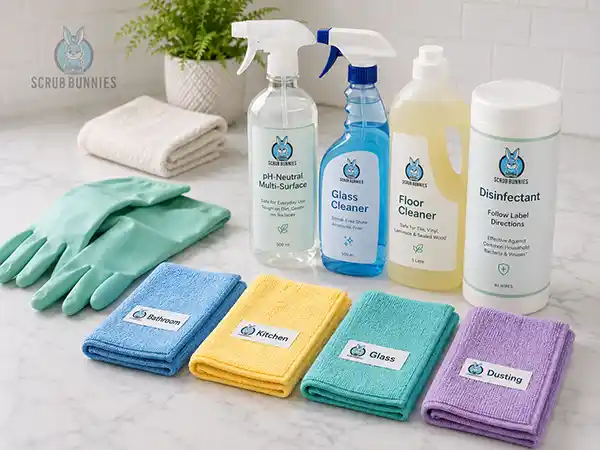
A good cleaner does not rely on strong smells or aggressive chemicals to prove a home is clean. They choose the right product, cloth and method for the surface.
- Ask about pH-neutral products for stone, sealed wood and delicate finishes.
- Ask for patch testing on unfamiliar fabrics, paintwork and specialist flooring.
- Confirm label-following, dilution and contact time where products need time to work safely.
- Check cross-contamination control, such as separate cloths for toilets, basins and kitchens.
- Expect ventilation and suitable PPE when stronger products are used.
Important safety warning: never mix cleaning chemicals. Bleach should not be mixed with descalers, acids, ammonia-based products or other cleaners, as dangerous fumes can be released.
Floor safety matters too. Wet mopping can leave smooth floors slippery, so the cleaner should manage drying time, dry paths and trailing cables.
How to Choose Well Before You Book
- Define the clean. Is it regular upkeep, a catch-up clean, a deep clean, or move-in/move-out cleaning?
- Ask for a task list. Clarify whether oven interiors, fridge interiors, inside windows, skirting boards, laundry and bed changing are included.
- Be honest about the starting condition. A home with heavy limescale, grease or clutter needs more time than a maintained home.
- Discuss tools and materials. Check whether they bring microfibre cloths, vacuum, mop system and surface-appropriate products.
- Check trust signals. Reviews, clear terms, insurance and a process for missed areas all matter.
- Agree access and boundaries. Discuss keys, alarms, parking, pets, valuables and rooms that are out of scope.
- Start with a realistic first visit. Many homes need a longer first clean before a shorter maintenance routine works properly.
Scrub Bunnies’ Insurance Verification page is helpful if you want to understand what an insurance status can and cannot confirm. For a broader local hiring guide, read Domestic Cleaning Services Near You: How to Choose Well.
[Add real cleaner quote, field note, or technician tip here]
Cost, Time and Value: Look Beyond the Hourly Rate
The cheapest hourly rate is not always the best value. One experienced cleaner working efficiently for three hours may achieve more than a cheaper option with poor tools, unclear priorities or unsuitable products.
Compare the whole arrangement: minimum booking time, travel charges, products, equipment, cancellation terms, VAT where applicable, and whether a re-clean process exists.
Common Mistakes People Make
- Choosing only by price, then expecting a deep clean in a regular cleaning slot.
- Not mentioning delicate materials such as marble, wool carpet, waxed wood or specialist upholstery.
- Assuming “insured” means every possible incident is covered without checking the detail.
- Leaving clutter everywhere, so paid cleaning time becomes tidying time.
- Not agreeing how feedback should be handled after the first visit.
Conclusion
The independent cleaner vs cleaning company decision is not about which is universally better. It is about fit. Independent cleaners often offer personal continuity and flexibility, while cleaning companies may offer more structure, cover and capacity.
Before booking, look for clarity, realistic timing, insurance, good communication and safe cleaning methods. A cleaner who asks sensible questions about products, surfaces, access and priorities is usually a better sign than one who simply promises to “do everything” in too little time.
Q&A
Is an independent cleaner cheaper than a cleaning company?
Sometimes, but not always. An independent cleaner may have lower overheads, while a company may include admin support, cover, insurance processes and team capacity. Compare the full service, not just the hourly rate.
Is a cleaning company safer than an independent cleaner?
Not automatically. Safety depends on insurance, training, product knowledge, communication and how problems are handled. A careful independent cleaner can be excellent, and a poorly managed company can still disappoint.
Should I give my cleaner a key?
Only after you are comfortable with the arrangement. Agree key handling in writing, avoid sharing alarm codes casually, and make sure access, locking up and emergency contact details are clear.
What should I ask before hiring a cleaner?
Ask what is included, who supplies products, whether they are insured, how they protect delicate surfaces, what happens if they cannot attend, and how feedback or missed areas are handled.
Can a cleaner use my cleaning products?
Yes, if they are suitable for the task and the cleaner is comfortable using them. Keep products in original containers with readable labels, and never ask a cleaner to mix chemicals.
Downloadable Resource
Questions To Ask Before Hiring Cleaner
Use this free checklist before booking a cleaner to compare your options with confidence. It helps you ask the right questions about insurance, cleaning products, task lists, access, reviews and delicate surface care, so you can choose a cleaner or cleaning company that suits your home, routine and expectations.
Questions To Ask Before Hiring Cleaner
Use this free checklist before booking a cleaner to compare your options with confidence. It helps you ask the right questions about insurance, cleaning products, task lists, access, reviews and delicate surface care, so you can choose a cleaner or cleaning company that suits your home, routine and expectations.
Further Reading
- Domestic Cleaning Services Near You
- Professional Deep Cleaning Services
- Find Cleaners Near You
- Domestic Cleaning Services Near You: How to Choose Well
- Insurance Verification
Authoritative Information
- HSE guidance on COSHH and cleaners
- HSE COSHH basics overview
- HSE guidance on cleaning and slip risks
- NHS guidance on how to wash your hands
- Acas guidance on employment status
Ready to Choose with Confidence?
Search local options, compare services and ask the right questions before you book. Start with Find Cleaners Near You and choose the cleaning support that genuinely fits your home.
Share Post
0 Comments